

When marketers talk about high-performing channels, they often default to digital: paid search, paid social, email automation, and retargeting platforms. But one channel consistently surprises brands with its profitability and that is direct mail.
When compared to digital tactics, direct mail continues to deliver exceptional ROAS, often outperforming online ads, especially in industries where trust, personalization, and household-level targeting matter most.
Let’s explore why direct mail works so well, how to calculate its ROAS, and what brands can do to maximize results. Direct Mail’s ROAS Advantage:
Direct mail cuts through digital noise
Modern consumers are bombarded with ads, literally thousands per day across social media, search engines, apps, and screens. Digital fatigue is real, and ad blindness has become a challenge.
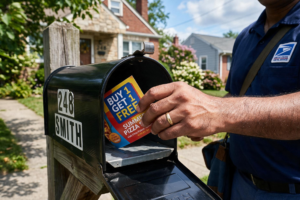
A physical mail piece, however, competes with far less clutter. It demands attention simply by being tangible and unexpected. This higher engagement leads to stronger response rates, which ultimately boost ROAS.
Response rates are dramatically higher than digital
Industry research continues to show:
- Direct mail averages 4 to 9% response rates, depending on audience and format.
- Paid social and display ads typically generate 0.5% or less.
- Even high-performing email campaigns land around 1 to 2%.
When response rates increase, cost per acquisition goes down and ROAS goes up.
- Direct mail performs exceptionally in retargeting
Direct mail is no longer limited to demographic lists and neighborhoods. With modern identity-based targeting, brands can send personalized mail to:
- Website visitors who abandoned carts
- Lapsed customers
- Loyalty members
- High-value households matched via CRM data
This hybrid of digital + physical results in ROAS that’s often 2–4x higher than digital retargeting alone.
Longer shelf life = more conversions
A Facebook ad disappears in seconds. A postcard might sit on a refrigerator, desk, or counter for days or even weeks.
This ongoing visibility increases the probability of action and another reason direct mail often beats digital from a ROAS perspective.

How to Calculate ROAS for Direct Mail
ROAS = Revenue Attributed to Direct Mail ÷ Direct Mail Spend
Example:
If you spend $10,000 on a direct mail campaign and generate $40,000 in measurable revenue:
ROAS = 4:1 (or 400%)
Brands in retail, home services, and subscription models often report 5:1 to 12:1 ROAS when campaigns are well optimized. What Drives Higher ROAS in Direct Mail Campaigns:
High-quality data & targeting
The tighter the audience, the stronger the return.
Using first-party CRM data or identity-based targeting consistently leads to the highest ROAS.
Personalization
Variable printing allows brands to tailor:
- Offers
- Images
- Messaging
- QR codes and URLs
- Location-specific content
The more tailored the piece, the higher the conversion rate.
Multi-touch attribution
Direct mail works even better when combined with:
- Paid social
- Retargeting ads
- SMS
Multi-channel exposure can increase ROAS by 20–40%.
Strong creative + simple offers
Consumers respond best to:
- Clear calls to action
- Limited-time offers
- Scannable QR codes
- Easy redemption paths
A well-designed postcard can outperform a complex multi-page mailer depending on the offer.
The Bottom Line: Direct Mail Is a ROAS Powerhouse
Despite being decades old, direct mail’s effectiveness has not declined, it has improved thanks to better data, better tracking, and better integration with digital channels.
Brands that invest in direct mail often discover:
- Lower acquisition costs
- Higher lifetime value customers
- Higher trust and engagement
- Significantly stronger ROAS than digital-only strategies
If you’re looking for a marketing channel that stands out, performs consistently, and delivers measurable returns, direct mail deserves a place in your marketing mix.