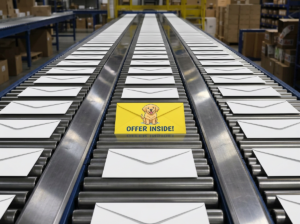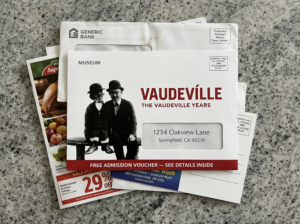


In a world saturated with emails, social ads, push notifications, and endless scrolling, something unexpected is happening, direct mail continues to outperform digital marketing.
While digital channels are essential, brands that rely exclusively on them are missing a powerful opportunity. Direct mail has evolved into one of the most effective, measurable, and profitable marketing channels available today. The following is an explanation of why.
Attention Is Scarce, and Direct Mail Captures It. The average professional receives over 100 emails per day. Most go unread. Many are automatically filtered into spam or promotions folders. Digital ads compete against thousands of messages in a single scroll session.
Physical mail faces far less competition. When someone checks their mailbox, they typically receive only a handful of items. There is no pop-up, no banner blindness, no notification fatigue. A well-designed mailer commands attention simply because it exists in a physical space.
Studies consistently show that, Direct mail has significantly higher open rates than email and recipients are more likely to read or at least scan physical mail. Direct Mail also stays in homes or offices for days, weeks and sometimes months. Digital content disappears in seconds. Mail lingers on.
Physical Media Creates Stronger Emotional Impact. Neuroscience research has shown that physical media requires more cognitive effort to process, leading to stronger memory retention and emotional engagement.
Holding a postcard, brochure, or dimensional package activates sensory experiences, touch, texture, weight, design and even scent in some creative executions. This sensory engagement creates a deeper psychological connection than pixels on a screen.
Direct mail often feels more personal and intentional. It signals effort. That perception of effort translates into higher trust and brand credibility. In industries where trust matters. finance, healthcare, real estate, B2B service, this advantage is substantial.
Trust in Digital Advertising Is Declining. Consumers are increasingly skeptical of digital advertising. Concerns about privacy and data tracking, Ad fraud, Bots, Ad overload, Banner blindness. In contrast, direct mail is perceived as more legitimate and less intrusive. There’s no tracking pixel spying on behavior. No algorithm deciding what to show. Just a direct message from brand to customer.
Direct Mail Has Less Competition. Digital advertising has become crowded and expensive, Cost-per-click continues to rise, Social platforms are saturated, Email inboxes are overwhelmed. When everyone competes in the same digital channels, response rates decline. Direct mail, however, is underutilized by many modern marketers. That creates opportunity. Less competition in the mailbox means, Hhgher visibility, Greater differentiation, Better recall, Stronger response rates Sometimes outperforming digital isn’t about being newer, it’s about being less crowded.
Response Rates Are Consistently Higher. Data from industry benchmarks consistently show that direct mail generates higher response rates than email or paid digital ads, especially for acquisition campaigns.
While digital campaigns often produce large volumes of impressions, impressions don’t equal action. Direct mail frequently generates higher response rates
- Higher conversion rates
- Larger average order values
- Better lifetime value
This is especially true in targeted campaigns where data is used intelligently.
Modern direct mail is not “spray and pray.” It’s data-driven, segmented, personalized, and highly trackable.

Direct Mail Enhances Digital. One of the biggest misconceptions is that direct mail and digital are competitors. They’re not. They’re complementary.
When used together:
- Direct mail boosts online traffic.
- QR codes and personalized URLs connect offline to online.
- Follow-up emails increase conversion from mail campaigns.
- Retargeting ads reinforce physical mail messages.
Multi-channel campaigns consistently outperform single-channel campaigns.
Direct mail often serves as a pattern interrupt, the moment that breaks through digital fate, digital channels support follow-up and measurement.
Mail Reaches Audiences Digital Misses. Not all demographics are equally reachable online.
- Older audiences may not engage heavily with social ads.
- High-net-worth individuals often ignore mass email.
- Decision-makers are shielded by spam filters and gatekeepers.
But everyone has a physical address.
Direct mail allows you to reach:
- Households
- Business decision-makers
- Geographic segments
- Specific property types
- High-value prospects
Address-based marketing gives precision that rivals digital targeting—without relying on cookies or third-party data.
Tangibility Increases Perceived Value. A physical piece of mail feels more valuable than an email.
Consider the difference:
- An email offering a free consultation
- A premium printed invitation offering the same
Which feels more important?
The physical format elevates the perceived value of the offer.
That perception influences behavior:
- People are more likely to keep it.
- More likely to act on it.
- More likely to associate the brand with quality.
In luxury markets and high-ticket services, this psychological lift matters.
Measurement Has Caught Up. A common objection to direct mail is measurability.
That argument is outdated.
Today, marketers can track:
- Unique QR codes
- Personalized URLs (PURLs)
- Coupon codes
- Call tracking numbers
- Address-based attribution
- CRM integration
Direct mail can be just as measurable as digital—and in some cases, more transparent because there are fewer layers of algorithmic interference.
You know exactly how many pieces were sent. You know exactly who received them.
Digital Fatigue Is Real. Consumers are tired of:
- Notifications
- Retargeting ads
- Inbox overload
- Auto-play videos
- Pop-ups
- Constant scrolling
Bottom Line, direct mail continues to outperform digital in key areas because it, commands attention, creates emotional impact, drives higher response rates, enhances digital performance and reaches audiences others miss. In a world drowning in digital noise, sometimes the most effective strategy is the one you can hold in your hands.